Buy Less, Build More
August 30, 2026
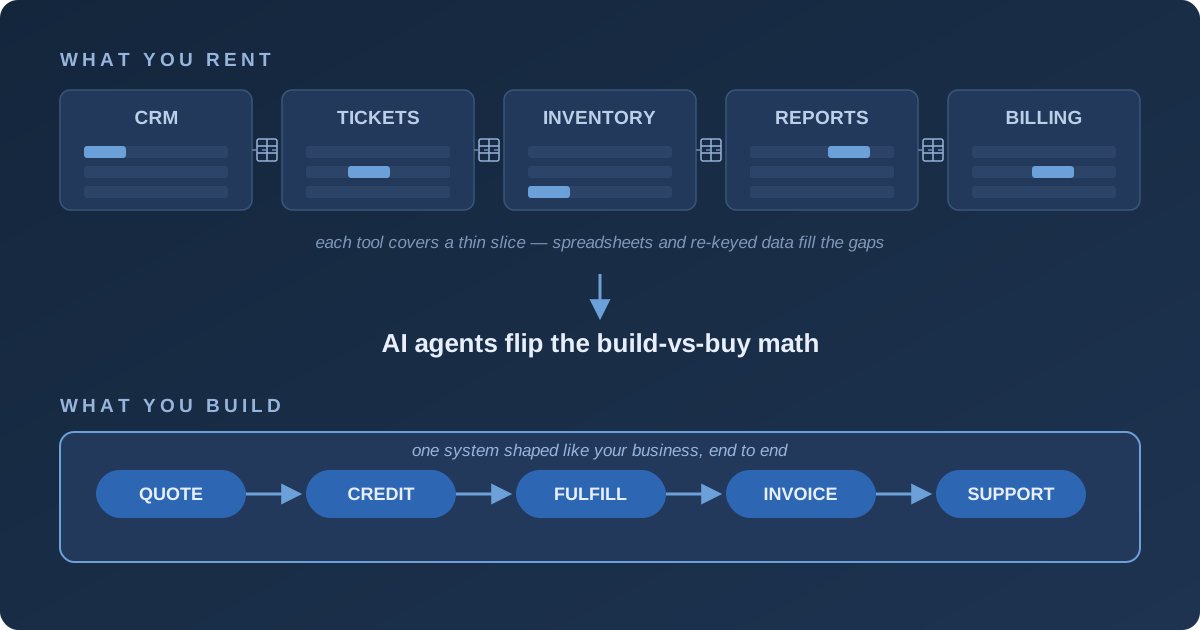
Walk through any mid-sized company and count the software subscriptions. A CRM, a ticketing system, a project tracker, an inventory tool, a reporting platform, a dozen smaller ones — each with its own login, its own data model, and its own idea of how your business works. Now count the spreadsheets. Those are the tell. Every spreadsheet is a place where the software you bought doesn't quite fit the business you actually run.
For the last thirty years, buying was the rational choice. Custom software was expensive to build and worse to maintain. Unless software was your business, you bought whatever got you 70% of the way there and staffed people around the gap. Entire job descriptions exist to ferry data from one tool to another and reconcile the differences in a spreadsheet.
What off-the-shelf software actually is
A vendor can only sell the same product to thousands of companies by building for the average of them. So every off-the-shelf tool is, by necessity, a myopic slice: it models one function — sales, support, inventory — the way a typical company does it, and stops at the edges of that function.
But nothing valuable in a business happens inside one function. A customer order touches quoting, credit, fulfillment, invoicing, and support. Each of those steps might be well-served by its own tool, while the flow — the thing that actually determines how fast and how well you serve the customer — belongs to no tool at all. It lives in email threads, re-keyed data, and the heads of the two people who know how everything connects. The distinctive shape of your business is precisely the part the software you rent can't see.
The math just flipped
AI agents collapse the cost of building software. Work that used to take a team a quarter now takes a small team weeks; much of the maintenance burden — the historical killer of custom software — becomes something agents handle too, with people reviewing and directing rather than typing every line. I've watched this firsthand: systems that would never have cleared the build-vs-buy bar three years ago are now cheaper to build than to license, integrate, and staff around.
When building gets cheap, the old logic inverts. Why rent a tool that models the average company's sales process when you can have software that models your order-to-cash flow, end to end, across every department it touches? Custom software stops being a luxury for tech companies and becomes the default way an operating company encodes how it works.
What this looks like
The companies that move first won't rip everything out. Commodity layers — payroll, email, accounting cores — stay bought; there's no advantage in rebuilding what's genuinely the same everywhere. The building happens one level up, where your process is your advantage:
- The quoting workflow that currently takes three tools and two days becomes one system that takes an hour.
- The weekly report assembled from four exports becomes a live view, because the systems underneath were built to share data rather than bridged after the fact.
- The tribal knowledge of "how we actually handle exceptions" gets encoded in software instead of retiring with the person who holds it.
The unit of software stops being the department and becomes the workflow. That's the efficiency off-the-shelf tools structurally cannot offer — they end where your org chart says a function ends, and your problems don't.
The honest caveats
This isn't free. Custom software still needs ownership: someone accountable for it, evaluations that catch drift, and guardrails around what agents ship. Companies that build without that discipline will recreate the legacy-system mess with faster tooling. And build-vs-buy is still a judgment call — the bar has moved, not vanished.
But the direction is clear. Software spend is shifting from renting the average company's workflows to building your own. The companies that learn to direct AI agents — not just adopt AI features inside the tools they already rent — will run on software shaped like their business, and it will show up everywhere: in cycle times, in headcount leverage, in how fast they can change.
The spreadsheets were telling you where to start all along.
Nick Stoddart is a CTO and fractional technology consultant based in Chattanooga, TN. He builds AI-first systems at Direct Commerce and advises growth-stage companies through Nick Stoddart Consulting.